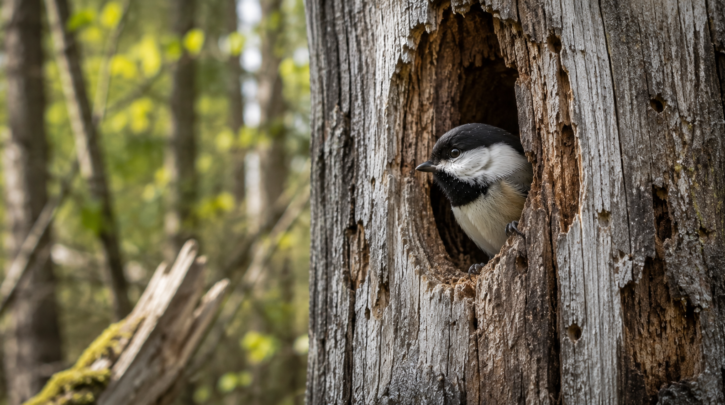

Chickadees sit right at the center of one of the more interesting ecological relationships: they’re one of the most direct beneficiaries of the excavation work woodpeckers leave behind.
This site participates in affiliate programs. If you buy through a link on this page, we may earn a commission at no extra cost to you. Affiliate disclosure
Why Old Woodpecker Cavities Matter So Much Here
Because chickadees can only excavate their own cavity in already-soft, decayed wood, an abandoned woodpecker cavity in firmer wood gives them access to nesting sites they could never have created themselves. Downy Woodpecker cavities in particular, with their relatively small entrance hole, are an especially good match for chickadee needs — a genuine direct link back to the excavation behavior of the woodpecker.
A Real Ecological Chain
This isn’t a coincidental overlap. Woodpeckers excavate a cavity, use it for one or two seasons, then move on, and the abandoned cavity becomes available to species like chickadees that depend on already-excavated holes far more than they depend on excavating hard wood themselves. Retaining dead wood on a property, covered in our attracting guide, supports this entire chain at once.
Nest Boxes as a Direct Substitute
Where natural cavities and old woodpecker holes aren’t available, a correctly sized nest box works just as well. The key detail is hole size: a chickadee box needs a roughly 1 1⁄8-inch entrance, noticeably smaller than the 1½-inch hole a bluebird box requires.
Should You Add Wood Shavings?
Some hosts partially fill a chickadee box with wood shavings, giving the birds a substrate to work through as though they were excavating, even inside an artificial cavity. This isn’t strictly necessary — chickadees will readily build a full nest in an empty box — but it’s a reasonable option for hosts who want to more closely mimic a natural excavation experience.
If you’d like to see that activity for yourself, the Birdfy Nest Duo is a camera nest box with a 1.1-inch entrance plate for chickadees and a camera inside the cavity.
Competition to Watch For
House Wrens can compete for chickadee-sized cavities in some regions, similar to the dynamic of bluebirds, and larger cavity-nesting species occasionally usurp a chickadee-occupied box outright. Because House Wrens are native and protected, management options are limited to spacing and habitat choices rather than direct removal.
A Genuine Callback
A property supporting active woodpeckers is, indirectly but genuinely, also supporting the chickadees that will move into those same cavities once the woodpeckers move on.
Ready to put up a box rather than wait for a natural cavity? See our nest box guide for models built to the correct hole size.
What Happens When Neither Option Is Available
On a property with no dead wood and no available nest box, chickadees simply won’t nest there at all, regardless of how good feeder-based food access might otherwise be — nesting habitat and feeding habitat are genuinely separate requirements, and a well-fed local population still needs somewhere suitable to actually raise a brood.
Why Correct Hole Size Matters So Much
A hole cut or drilled too large defeats much of the purpose of a nest box in the first place, opening the cavity to larger competitors and predators that a correctly sized 1 1⁄8-inch entrance would otherwise exclude. Checking hole diameter periodically on an older box, particularly one that squirrels or woodpeckers may have gradually enlarged, is a reasonable maintenance habit.
A Property-Level View of Cavity Availability
Thinking about cavity availability at the scale of an entire property, rather than a single box or tree, gives a more realistic picture of how well a yard actually supports chickadees — a mix of retained dead wood, tolerance for old woodpecker cavities, and one or two correctly sized boxes together offer considerably more nesting flexibility than any single option alone.
A Two-Site Relationship Worth Understanding
Anyone who has already read about woodpeckers will recognize this content as a direct continuation — the same standing dead wood that supports an active woodpecker population this year is quietly setting up next year’s chickadee nesting options, whether or not the property owner ever connects the two.
A Modest Investment With a Real Payoff
Between retaining a little dead wood and putting up one correctly sized nest box, the total investment required to genuinely support chickadee nesting is modest compared to the effort involved in supporting some other cavity-nesting species, making it a reasonably accessible project even for a first-time host new to backyard birding.