
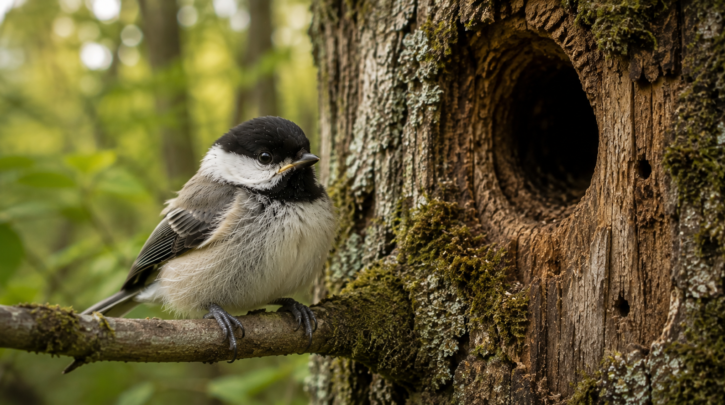

A chickadee brood of six to eight chicks is considerably larger than most other cavity-nesting songbirds attempt at once, and feeding that many growing chicks becomes a genuinely demanding, nearly nonstop effort for both parents.
At Hatching
Newly hatched chickadees are altricial: blind, featherless, and completely dependent on their parents. Because the female incubates alone and typically doesn’t begin full incubation until the clutch is complete, as covered in our eggs guide, most or all of a large clutch hatches within roughly a day of each other.
A Nonstop Feeding Effort
With six to eight chicks to feed, parents make an extraordinary number of feeding trips per day, delivering caterpillars and other insects almost continuously through daylight hours. This volume of feeding activity is a direct consequence of the unusually large clutch size covered in our eggs guide — a smaller brood simply wouldn’t require anywhere near this level of sustained effort.
Nestling Period
Chicks typically fledge roughly 16 to 19 days after hatching, a timeline broadly comparable to many other small songbirds, though the sheer volume of food required to reach that point is considerably higher given the brood size.
Why Territory Quality Matters So Much Here
Because a full brood requires such a large volume of insect prey, the insect-supporting habitat quality of a pair’s territory directly determines how many chicks actually survive to fledging — a territory rich in caterpillar-supporting native plants, covered in our attracting guide, can make the difference between fledging most of a large clutch and losing chicks to insufficient food.
The Hissing Defense in Nestlings
Older nestlings disturbed inside the cavity can perform the same startling, snake-like hissing display covered in our nest cavity guide, suggesting this defense isn’t limited to incubating adults and may serve the whole brood as a deterrent against a predator or intruder reaching into the nest.
Fledging and Early Independence
Fledglings leave the cavity capable of short flights but remain dependent on parents for continued feeding and protection for several weeks afterward, gradually picking up the caching and foraging skills that will support their first independent winter.
Learning to Cache
Young chickadees don’t cache food efficiently right away — the spatial memory system covered in our lifespan guide develops and improves with practice over the following months, meaning a fledgling’s first attempts at hiding food are considerably less organized than an experienced adult’s.
If You Find a Fledgling on the Ground
A young chickadee found on the ground or a low branch, not yet flying well, is usually not abandoned — this is a normal transitional stage, and a parent is very likely nearby continuing to feed and supervise it. As with most fledgling songbirds, leaving it alone unless it’s in clear, immediate danger is almost always the right approach.
Want to help the next brood get a strong start? Revisit our attracting guide for the native plants that make feeding a brood this large genuinely possible.
How Parents Divide the Workload
Both parents share feeding duties fairly evenly through the nestling period, since raising a brood this large simply isn’t manageable through the effort of a single adult. This shared workload continues into the post-fledging period as well, with both parents typically involved in supervising and feeding young after they’ve left the cavity.
Brood Reduction in Poor Conditions
In years or territories with genuinely poor insect availability, not every chick in a large clutch survives to fledging — a natural adjustment to available resources rather than a sign of parental failure, and one more reason habitat quality matters so directly to overall reproductive success for this species specifically.
A Single Brood, Generally
Given how demanding a full brood of six to eight chicks already is, chickadees typically attempt only one nesting effort per season under normal conditions, unlike a House Finch managing multiple broods or a bluebird attempting two or three — the sheer scale of a single chickadee brood already represents a full season’s reproductive effort.
A Demanding but Rewarding Season
Watching a pair manage this level of feeding effort day after day for nearly three weeks is a genuinely impressive thing to observe up close, and it offers a clear, visible illustration of just how much a large clutch size actually demands from two adult birds working together continuously without much rest along the way.
Final Thoughts
A brood this large is a genuine test of everything covered across this site, from insect-rich native habitat to a correctly sized cavity, all coming together during just a few demanding weeks each summer.