
Unlike a bluebird, an oriole, or even a woodpecker with its subtle head markings, chickadees offer almost nothing to go on visually. Across all five common species, males and females look essentially identical in the field.
A Genuinely Monomorphic Family
Black-capped, Carolina, Mountain, Boreal, and Chestnut-backed Chickadees all show the same pattern: no meaningful difference in cap color, back color, or any other plumage feature between the sexes. This puts chickadees in the same category as Pine Siskin on the finch side of backyard birding — a species where sex genuinely can’t be reliably determined by looking alone, regardless of lighting or viewing angle.
Subtle Average Differences That Aren’t Field Marks
Some research has found that males average very slightly larger than females in certain populations, but the overlap between individual birds is far too great to use size as a practical field mark — you would need two birds side by side, and even then, you’d be relying on a small statistical average rather than a clean visual signal.
Behavior Is More Useful Than Plumage
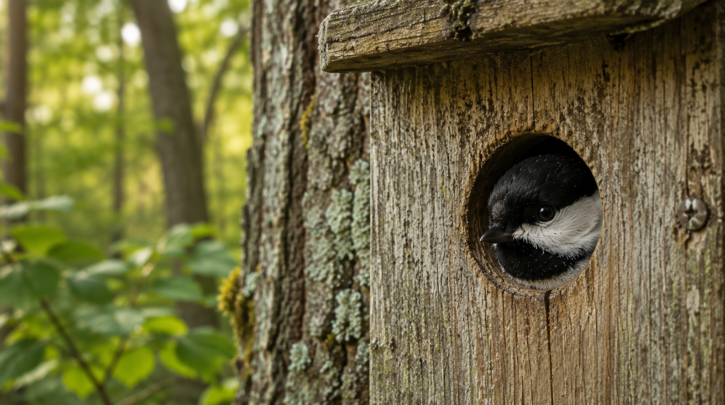
During the breeding season, a few behavioral patterns offer better clues than appearance ever could. Incubation is handled by the female alone, so a bird spending long, continuous stretches inside a nest cavity during the egg and early-chick stage is almost certainly the female. Males sing considerably more than females, particularly during spring territory establishment, so a persistently singing bird nearby is more likely male, though females do occasionally vocalize as well.
Excavation Behavior
Both sexes participate in excavating a nest cavity when the pair chooses to dig one rather than reuse an existing hole, covered in our nest cavity guide, so watching who’s excavating won’t reliably indicate sex the way incubation behavior does later in the nesting cycle.
How Researchers Actually Determine Sex
Because visual identification isn’t possible, researchers studying wild chickadee populations typically rely on molecular sexing from a small blood or feather sample, or on direct behavioral observation at an active nest, rather than any plumage-based method. Banding studies that need confirmed sex data almost always use one of these more invasive or labor-intensive approaches rather than a field guide comparison.
Why This Pattern Exists
Species that rely heavily on visual display during courtship, like a bluebird or an oriole, tend to show stronger sexual dimorphism, while a highly social, flock-oriented species like a chickadee may simply not benefit as much from visually distinguishing the sexes outside the breeding season, when most day-to-day social structure is organized around the dominance hierarchy covered in our winter survival guide rather than around sex at all.
A Practical Takeaway for Backyard Hosts
Don’t spend time trying to sex an individual chickadee by looking at it — it genuinely isn’t possible with any reliability. If you want to track a specific pair through a nesting attempt, watching for the incubation behavior described above is a far more productive approach than any visual comparison.
Curious what chickadees actually sound like, and what those sounds mean? See our chick-a-dee call guide for the surprisingly sophisticated communication system behind the species’ name.
Comparing to Other Birds
Chickadees join Pine Siskin as one of the few genuinely monomorphic species, standing apart from the head-marking pattern seen in woodpeckers, the overall-color-saturation pattern seen in bluebirds, and the black-versus-no-black pattern seen in orioles. This makes chickadees a useful reminder that visual sexual dimorphism isn’t universal even among common, easily observed, genuinely familiar backyard birds.
Why Some Species Skip Visual Dimorphism
Species that maintain stable, cooperative flocks for much of the year, as chickadees do, may simply gain less evolutionary benefit from visually advertising sex outside a brief breeding window, compared to species where visual competition for mates plays a larger, more ongoing role in day-to-day social structure and territory.
What This Means for Everyday Birdwatching
For most backyard observation, not being able to sex an individual chickadee doesn’t meaningfully limit the experience — identification, behavior, and the sophisticated vocal communication offer plenty to observe and enjoy without needing to determine which bird is which sex on any given visit.
A Trait Worth Remembering
Next time a plumage-based sexing trick seems to work on a chickadee, it’s worth double-checking against actual behavior, since the visual differences people sometimes report are rarely consistent enough to hold up across a genuinely large sample of birds observed over more than a single season or a single flock at one particular feeder.