
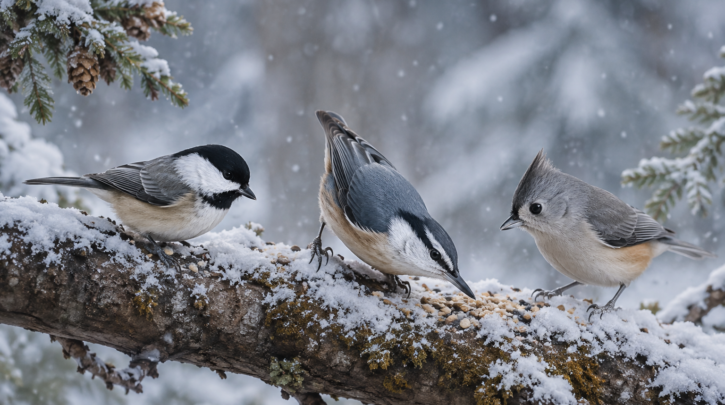

Winter is where every adaptation covered across this site converges at once — the fall caching effort, the dominance hierarchy, and the nightly torpor all come together to get chickadees through the coldest stretch of the year.
Dominance Hierarchy in Full Effect
By winter, the flock’s dominance hierarchy is fully established, and rank directly shapes which birds get the best access to feeding and caching sites during the leanest weeks, as covered in our lifespan guide.
Solo Roosting and Nightly Torpor
Despite flocking together during the day, chickadees typically roost alone overnight, entering the controlled, reversible hypothermia called torpor to conserve energy through genuinely cold nights. See our winter survival guide for the full mechanics of this adaptation.
Putting the Fall Cache to Use
All that fall caching activity pays off directly in winter, as birds draw on thousands of previously hidden food items using the seasonally enhanced spatial memory described in our lifespan guide. This cached food supplements whatever natural insects and seed remain available, along with feeder food where offered.
Mixed Flocks and the Chickadee Nucleus
Winter is when chickadees most visibly serve as the organizing nucleus for mixed foraging flocks, with nuthatches, titmice, and other species traveling alongside them and responding to the chick-a-dee alarm call covered in our call guide.
Pairing Quietly Begins
Late winter is also when pair formation within the flock, covered in our FAQ, begins to take shape — a subtle transition that sets up the smoother spring territory establishment described in our spring guide.
Feeder Demand Peaks
Suet, sunflower, and peanut feeders typically see their heaviest use of the year during winter, since natural insect prey is completely unavailable and cached food alone may not cover every day’s energy needs. See our suet feeder guide for keeping a station stocked through this peak-demand stretch.
Window Feeding at Its Best
Winter is also when window feeders, covered in our window feeder guide, tend to see their most reliable activity, since chickadees are especially motivated to visit a dependable food source during the coldest, most resource-scarce stretch of the year.
Ready for whatever winter brings? Revisit our feeder guide to make sure suet, sunflower, and peanuts are all covered before the coldest weeks arrive.
A Fitting Close to the Chickadee Year
Winter draws together nearly every distinctive piece of chickadee biology covered throughout this site — memory, physiology, and social structure — into a single, genuinely high-stakes seasonal test, before the flock quietly begins pairing off again and the whole cycle starts over.
What Backyard Hosts Can Do
- Keep suet, sunflower, and peanut feeders stocked through the coldest stretches
- Retain natural cavities and dense cover that support solo overnight roosting
- Avoid disturbing roosting sites during the harshest parts of winter
- Watch for unusually large flocks that might signal an irregular irruptive movement
A Season Worth Slowing Down For
Because so much of winter chickadee behavior happens quickly and at close range — a feeder visit, a brief territorial exchange within the flock — genuinely patient, unhurried observation tends to reveal far more than a quick glance ever could.
A Genuinely Different Winter Than Much Other Species
Where an oriole host sees nothing at all during winter and a finch host faces genuine uncertainty about whether irruptive species will appear, a chickadee host gets a steady, visible, and behaviorally rich presence all season long, supported by adaptations built entirely around staying put rather than leaving.
Looking Back at a Full Year
From quiet winter pairing, through spring territory and a demanding summer brood, to fall caching and a fully reformed flock, the chickadee year is a genuinely complete cycle that plays out almost entirely within the same small home range, adapting behavior rather than location as the calendar turns.
A Closing Thought on This Family
Across every season covered on this site, the same theme keeps reappearing: flexibility. Flexible nesting strategy, flexible migration behavior, and a genuinely flexible social structure that shifts from cooperative daytime flocking to solitary overnight survival and back again, day after day, all winter long.
Few backyard birds embody this kind of adaptability quite as consistently as the chickadee does across a full calendar year — making it one of the most genuinely rewarding species to watch closely, for as long as the feeders stay filled, the trees stay standing, and the cavities remain available.