
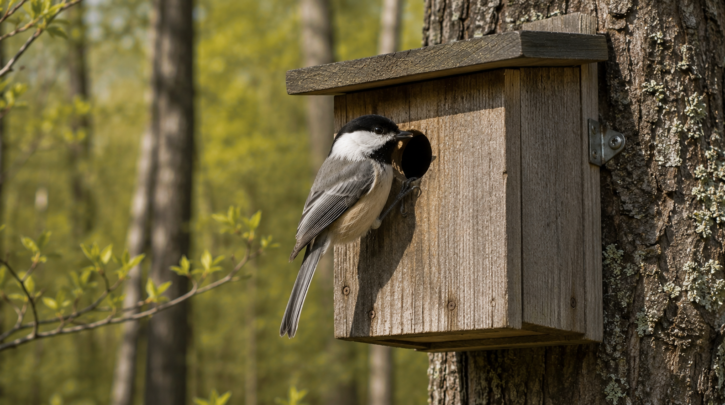

A leftover bluebird box won’t serve chickadees well — the entrance hole is simply too large. Our top pick is the Birdfy Nest Duo, a camera nest box that comes with a chickadee-sized entrance, followed by two simpler wooden boxes. See our full nest cavity guide for why hole size matters so much for this species specifically.
What We Looked For
- A correctly sized entrance hole, roughly 1 1⁄8 inches in diameter
- Solid wood construction with built-in ventilation and drainage
- An openable panel for end-of-season cleaning
- Reasonable predator resistance around the entrance
Birdfy Nest Duo: Our Top Pick
The Birdfy Nest Duo is a nest box with two cameras, one inside the cavity and one outside facing the entrance, plus built-in audio, so you can follow nest building, the unusually large chickadee clutch, and fledging from your phone without opening the box. It ships with four entrance plates, including a 1.1-inch size that sits within a hair of the recommended 1⅛ inches for chickadees, and metal guards around the entrance to discourage predators.
Some owners add a thin layer of wood shavings to the floor before the season, which gives a nesting pair a solid base to build on — see the note on shavings below. The box needs a spot within range of your home Wi-Fi, and it costs more than a plain wooden house. You can check current pricing for the Birdfy Nest Duo on Birdfy’s site.
Runner-Up: Duncraft Eco-Chickadee Bird House
Built specifically around chickadee dimensions, with ventilation and drainage designed to keep nestlings comfortable through a range of weather conditions. Its correctly sized entrance and compact overall footprint make it a purpose-built option rather than a general-purpose birdhouse repurposed for chickadees.
Also Good: Duncraft Garden Wren & Chickadee House
A cedar box sized to suit both House Wrens and chickadees, useful for a property that might attract either species depending on the season and local competition. Cedar construction offers natural weather resistance without chemical treatment.
Duncraft Birdkeeper’s Bird House
An overhanging roof and top-mounted entrance design that makes it genuinely difficult for a climbing predator to reach inside, with a side-hinged front panel for easy cleaning between broods. This top-entrance style is worth considering specifically in areas with higher predator pressure.
A Note on Wood Shavings
Some hosts add a thin layer of wood shavings to a new box, letting chickadees work through a loose substrate the way they might in a naturally soft, decayed cavity. This isn’t required — chickadees will nest successfully in an empty box — but it’s a reasonable option for anyone who wants to more closely mirror a natural excavation experience, and it gives a solid base in any box with a ventilated floor. It’s covered in more detail in our old cavities guide.
Placement
Mount five to fifteen feet up on a pole or tree trunk, ideally with some overhead canopy cover nearby, matching the relatively low, sheltered cavity height chickadees favor in the wild.
Ready to watch activity up close once a pair settles in? See our window feeder guide for gear that brings chickadees right up to the glass.
Cleaning Between Seasons
Remove old nest material after a brood fledges and give the box a light cleaning before the next breeding season, since chickadees generally build a fresh nest rather than reusing a previous season’s cup directly.
Checking Hole Size Over Time
Wood can shift slightly and hole edges can wear or be enlarged by other wildlife over several seasons of use, so periodically checking that the entrance still measures close to the correct 1 1⁄8-inch diameter is a reasonable maintenance habit for an older box.
One Box or Several
A single correctly sized box is often enough for a typical residential yard, though larger properties with more extensive habitat can reasonably support multiple boxes spaced to reduce territorial competition between pairs during the breeding season.
Monitoring an Occupied Box
Once a box shows signs of activity — regular visits, nest material being carried in — brief, infrequent checks are generally low-risk for this species, though keeping disturbance to a minimum during the first several days after eggs appear remains good practice regardless. A camera box like the Nest Duo removes most of the need to open the box at all.
Dealing With Unwanted Occupants
A box taken over by House Sparrows or another unwanted species should be addressed promptly, since chickadees are unlikely to attempt a nearby nesting effort while active competition persists at the same site.
A Modest Investment With Reliable Results
Compared to some of the more elaborate nest box requirements, a chickadee box is a genuinely accessible project — inexpensive, straightforward to install, and likely to see use given how readily this species accepts a correctly built box.
Final Thoughts
Getting the hole size right matters more than any other single detail — a correctly sized 1⅛-inch entrance on an otherwise simple box will consistently outperform an elaborate box with the wrong opening, regardless of what other features that fancier alternative might offer.
A correctly sized, well-placed box is likely to see genuine use within the first year or two, making this one of the more reliably rewarding nest box investments — and one of the more straightforward, achievable over a single weekend with basic tools.