
Between them, the five common chickadee species cover nearly every forested region of North America, from suburban deciduous woodland to the edge of the Arctic tree line.
Black-capped Chickadee
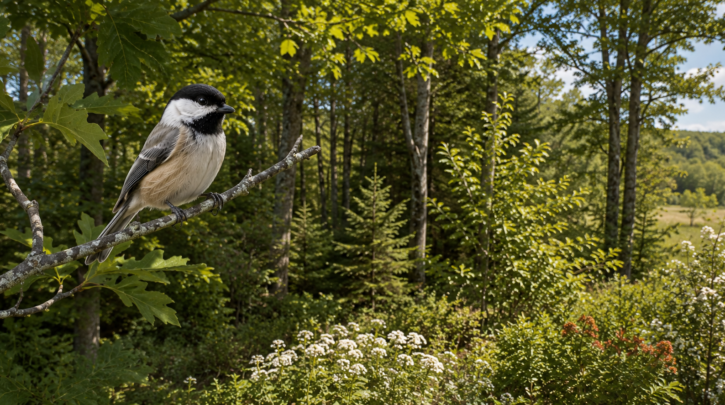
Found across most of Canada and the northern half of the United States, in deciduous and mixed woodland, forest edges, and suburban yards with reasonable tree cover. This is the most widespread and familiar species across the northern tier of the continent.
Carolina Chickadee
Occupies similar habitat to Black-capped — deciduous and mixed woodland, forest edges, suburban yards — but across the southeastern United States, meeting Black-capped in the hybrid zone covered in our identification guide.
Mountain Chickadee
Found in coniferous forest across the mountainous western United States and western Canada, generally at higher elevations than the habitat favored by Black-capped or Carolina.
Boreal Chickadee
Restricted to boreal and taiga conifer forest across Canada and Alaska, rarely appearing far south of the Canadian border. This is the most northerly of the five species and the least likely to be seen at a typical backyard feeder outside its core range.
Chestnut-backed Chickadee
Found in humid coastal conifer forest from southern Alaska down through coastal California, closely tied to the wetter, denser forest typical of the Pacific Northwest.
A Family Built Around Trees
Across all five species, some form of tree cover is a near-universal requirement — unlike a species such as Northern Flicker, which spends meaningful time foraging on open ground, chickadees remain closely tied to trees and shrubs for both feeding and nesting throughout their range.
Suburban and Urban Tolerance
Black-capped and Carolina Chickadees in particular tolerate suburban development well, provided reasonable tree cover remains. Mountain, Boreal, and Chestnut-backed Chickadees generally require more substantial natural forest habitat and are less likely to be regular visitors in heavily developed areas.
Curious whether local chickadees stick around all year or show any seasonal movement? See our migration guide for the details.
Range Overlap and Elevation
Mountain and Chestnut-backed Chickadees overlap in parts of the Pacific Northwest, generally separated more by elevation and forest type than by strict geographic boundary. Boreal Chickadee overlaps broadly with Black-capped across the Canadian boreal forest, distinguished immediately by the brown-versus-black cap covered in our identification guide.
Microhabitat Preferences Within Range
Even within a broadly suitable region, chickadees favor areas with a genuine mix of tree sizes and some understory shrub layer over a sparse, heavily manicured landscape, since this structural diversity supports both the insect populations chickadees rely on during the breeding season and the dense cover favored for solo overnight roosting in winter.
Why Structural Diversity Matters More Than Tree Count Alone
A yard with a handful of different tree and shrub layers — canopy trees, smaller understory trees, and shrubs closer to the ground — generally supports chickadees better than an equivalent number of trees planted with no layered structure at all, since different layers support different insect communities and offer different roosting and foraging opportunities.
A Family Adaptable Enough to Anchor a Whole Continent
Between the five species, chickadees demonstrate genuine adaptability across an enormous range of climate and forest type, from humid Pacific coastal rainforest to the edge of Arctic tundra, while maintaining broadly similar core behavior and biology across every population.
What This Means for Identifying Local Species
Knowing which chickadee species is expected in a given region, based on the range information above, is often a faster first step toward confident identification than working through plumage differences alone, particularly in areas where only one species is realistically present and the identification question is effectively already settled by location.
A Reasonable Starting Assumption
For most backyard hosts in North America, the local chickadee is very likely either Black-capped or Carolina depending on latitude, mainly relevant to hosts near the hybrid zone or living within range of one of the three more regionally restricted species found farther from the most common suburban range.
Final Thoughts
Range alone answers most identification questions before plumage ever needs to settle the matter, which is a genuinely useful shortcut worth remembering before working through any of the finer field marks covered in more detail elsewhere throughout this guide.
Combining range with even a rough sense of local forest type — deciduous, coniferous, or coastal — narrows the identification question down to one, or at most two, realistic candidates in nearly every part of North America.