
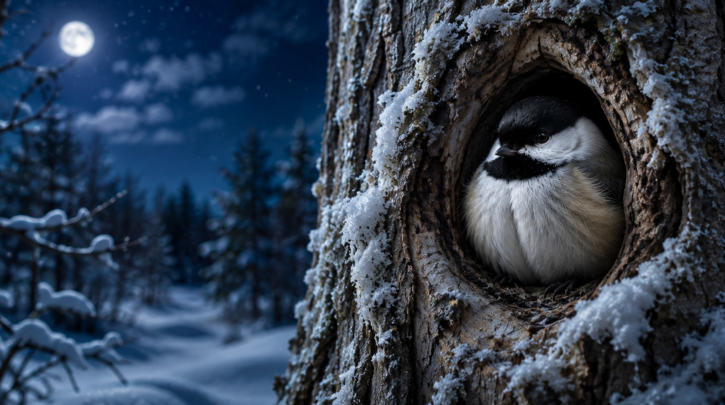

A bird this small surviving genuinely brutal winter nights seems almost implausible without understanding the specific combination of adaptations chickadees rely on — not one single trick, but several working together.
This site participates in affiliate programs. If you buy through a link on this page, we may earn a commission at no extra cost to you. Affiliate disclosure
Nightly Torpor: Controlled, Reversible Hypothermia
Chickadees can lower their body temperature by a meaningful margin — documented drops of roughly 10 to 12 degrees Celsius below normal have been recorded — for several hours overnight during especially cold conditions. This is a genuinely controlled, reversible state called torpor, distinct from true hibernation, that significantly reduces the energy a bird needs to burn just to stay alive through a long winter night.
Scatter-Hoarded Food and a Remarkable Memory
Thousands of individually cached food items, hidden throughout a bird’s home range over the preceding fall, provide a steady supplemental food source through winter. See our lifespan guide for the seasonal hippocampal growth that supports the spatial memory needed to actually relocate a meaningful share of these caches later.
Solo Roosting Despite Daytime Flocking
Despite spending winter days in a social flock, chickadees typically roost alone overnight, each individual settling into its own separate cavity or dense cover rather than huddling together the way some other species do. This solo roosting pattern is a genuine contrast to the cooperative daytime flocking behavior the same birds show just hours earlier.
Feather Fluffing for Insulation
Like most winter birds, chickadees fluff their feathers to trap a thicker layer of insulating air against the body, a simple but effective behavioral adaptation that works alongside torpor rather than replacing it.
Dominance Hierarchy and Food Access
Winter flocks maintain a stable dominance hierarchy, covered in more detail in our lifespan guide, and a bird’s rank directly affects how much reliable access it has to the best feeding and caching sites during the leanest stretches of the season.
Chickadees as the Nucleus of Mixed Winter Flocks
Chickadees frequently serve as the organizing “nucleus” species around which mixed winter flocks form, with nuthatches, titmice, kinglets, and even woodpeckers often traveling alongside a chickadee flock and responding to its calls. The chick-a-dee alarm call covered in our call guide effectively functions as an early warning system for the entire mixed flock, not just for chickadees themselves.
A chickadee surviving a brutal winter night isn’t relying on one adaptation but several stacked together — controlled hypothermia, a remembered cache, and a stable social structure that determines who eats first.
Want to support chickadees through the toughest stretch of winter? See our suet and seed guide for the food that matters most when natural options and cached food both run low.
Why This Combination Is Genuinely Unusual
Few backyard birds combine a cognitive adaptation this sophisticated, a physiological adaptation this dramatic, and a social structure this stable all in service of surviving a single season, making winter chickadee survival one of the more genuinely remarkable stories in the bird worl.
Comparing to Other Cold-Weather Adaptations
Common Redpoll survives Arctic cold through an entirely different mechanism — an expandable esophageal pouch for overnight seed caching rather than controlled hypothermia. Woodpeckers rely primarily on excavated roost cavities for shelter. Chickadees are unusual in combining several distinct strategies at once rather than leaning on any single dominant adaptation.
Energy Budgets on the Coldest Nights
On the very coldest nights, the combination of torpor, a sheltered roost site, and fluffed feathers together can make the difference between a bird surviving until morning and one that doesn’t, particularly for lower-ranked individuals with less reliable access to the best feeding and caching sites during the preceding day.
What a Backyard Host Can Do
- Keep suet and sunflower feeders stocked and accessible through the coldest stretches
- Retain natural cavities and dense shrub cover that support solo overnight roosting
- Avoid disturbing roosting sites during the coldest parts of winter
- Provide water where possible, since natural water can freeze over for extended periods
A camera feeder like the Birdfy Feeder also lets you keep an eye on your winter regulars from indoors, recording every visit on the coldest days.
A Season That Tests Every Adaptation at Once
A single genuinely brutal winter night puts torpor, cache memory, roost site quality, and flock rank all to the test simultaneously, which is part of why winter mortality remains meaningfully higher than mortality during the rest of the year despite this impressive combination of survival strategies.
A Fitting Capstone to Chickadee Biology
Winter survival draws together nearly every distinctive piece of chickadee biology covered across this site — memory, physiology, and social structure — into a single, genuinely high-stakes seasonal test that few other backyard birds face with quite this many adaptations working in concert.