
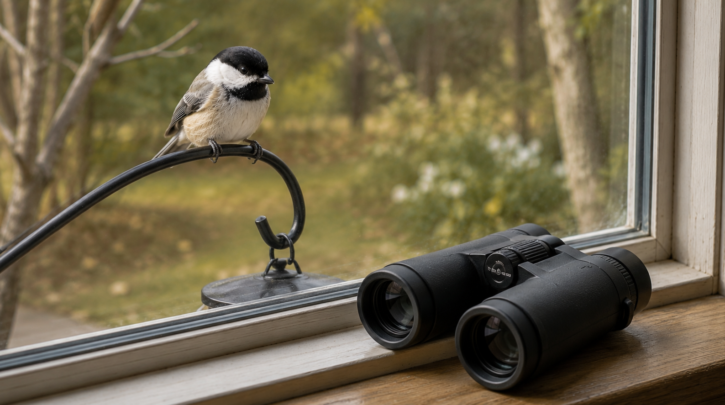

The chickadee landed on the shepherd’s hook holding my window feeder, about three feet from the glass, and I did what anyone with a brand-new pair of binoculars would do: I lifted them straight to my eyes. What I got was a soft, unfocusable gray-and-black blur, close enough that I could hear the bird’s feet on the metal but too close for the glass in my hands to make any sense of it at all.
The Bird Was Right There. My Binoculars Weren’t.
I kept turning the focus wheel, expecting the image to snap into place the way it had in the store when I’d tested a display pair on a bird twenty feet up in a tree. It never did. The chickadee hopped, grabbed a sunflower seed, and was gone before I found the edge of what my binoculars could even see. I lowered them, genuinely confused, and it took a second visit — same bird, same feeder, same three feet of distance — before I understood the problem wasn’t me. It was the spec sheet I hadn’t read closely enough.
What “Close Focus” Actually Means on the Spec Sheet
Most general-purpose binoculars, including plenty of well-reviewed birding models, list a minimum focus distance somewhere between 8 and 12 feet. That number barely registers as a limitation for most birds — a distant warbler or a hawk on a wire is never going to be a problem. But a chickadee at a feeder, or working through a low shrub while you’re standing three feet away with your coffee, routinely sits well inside that dead zone. The bird is close enough to see with the naked eye in perfect detail and too close for the optics to focus on it at all, which is a genuinely strange thing to experience the first few times it happens.
Once I knew to look for it, the number showed up right there on the box every time — some pairs focus down to 6 feet, a few genuinely exceptional ones closer to 5, and it’s the single spec that made the biggest practical difference of anything I checked before buying a replacement. A binocular with an 8×42 configuration and excellent glass is still the wrong tool if its close-focus distance is 10 feet and the bird you’re watching most often is at 3.
Then It Was Gone, and Three Others Took Its Place
A few weeks later, with a pair that actually focused close, I sat by the same window and watched a single chickadee turn into four in about ninety seconds — it grabbed a seed, ducked into the lilac, and was immediately replaced by a titmouse, then another chickadee, then a nuthatch working headfirst down the trunk behind them. Trying to track that kind of motion with a narrow field of view is like trying to watch a tennis match through a mail slot; by the time you’ve found one bird in the eyepiece, it’s already moved and you’re hunting for it again instead of actually watching it.
A wide field of view — usually printed as a number of feet visible at 1,000 yards, with wider being better — matters more for chickadees than for almost any other backyard bird precisely because of how constantly they move. They don’t perch and pose. They forage in short, sharp bursts between a dozen different branches a minute, and a binocular that shows you a generous slice of the yard at once means you can follow that motion instead of losing the bird every time it hops.
An Hour Later, My Arms Knew Exactly How Much the Binoculars Weighed
Chickadee watching, more than almost any other kind of birding I do, tends to happen sitting down. It’s not a hike where binoculars come up for thirty seconds and go back in a bag — it’s a chair near a window or a spot on the porch, coffee within reach, watching the same feeder for however long the activity keeps up. On a good morning that’s an hour or more, and a full-size 8×42 that felt perfectly reasonable in the store starts to feel considerably heavier by the time you’re holding it up for the fifteenth time that session.
Switching to a lighter compact pair — something in the 8×32 range rather than a full-size 42mm — was a genuinely bigger comfort improvement than I expected going in. The light loss compared to a 42mm objective barely registers during a mid-morning feeder-watching session in decent light, and not fighting arm fatigue means longer, more relaxed sessions instead of cutting a good chickadee flurry short because my hands needed a break.
The Combination I Actually Use Now
What ended up working, after that first frustrating pair, was a lightweight roof-prism 8×32 with a stated close focus under 6 feet and a noticeably wide field of view for its class. None of those three things shows up as clearly on a store shelf as magnification or lens size does, which is probably why I missed all of them the first time around — the box makes a much bigger deal out of “8×42” than it does out of the close-focus number buried in the fine print. For a bird that’s genuinely often closer than most binoculars can even resolve, that fine print turned out to be the whole ballgame.
Once the optics stopped being the bottleneck, it got a lot easier to actually use what’s in our species identification guide — a crisp, close, steady image is what makes it possible to catch the difference between a Black-capped Chickadee’s clean black cap and a Boreal Chickadee’s warm brown one, or to pick out the pattern differences covered in our chickadee vs. titmouse vs. nuthatch comparison in the half-second before a bird moves again.
Why This Pays Off Most on the Long Sessions
The sessions where this all matters most aren’t quick five-minute check-ins — they’re the long, unhurried stretches described in our piece on how often chickadees visit feeders, where the same handful of birds cycle through a feeder dozens of times over the course of a morning. A binocular that focuses close, shows a wide slice of the yard, and doesn’t wear out your arms turns that whole stretch into something worth settling in for, rather than a few good looks bookended by fumbling with the focus wheel.
If You Want to Go Deeper on the Specs
For anyone who wants the fuller rundown on magnification, prism types, and lens coatings beyond what mattered most for my own chickadee-watching setup, B&H’s birding binoculars guide covers the broader buying considerations in more depth, including how 8×42 and 10×42 pairs compare for general birding beyond the close-range case a feeder full of chickadees presents.
None of this means you need to spend a fortune. It means reading past the magnification number on the box to the close-focus spec most retailers list a few lines down, and choosing weight and field of view with an actual, honest picture of how you watch birds — for chickadees, that’s up close, for a while, and rarely standing still.