
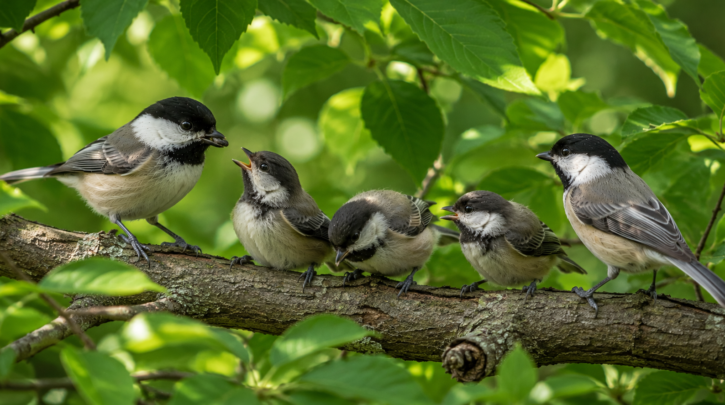

Summer covers the most physically demanding stretch of the chickadee year — incubating and then feeding a brood that can run six to eight chicks, followed by a fledging period that keeps both parents working well after the eggs have hatched.
This site participates in affiliate programs. If you buy through a link on this page, we may earn a commission at no extra cost to you. Affiliate disclosure
Incubation
The female incubates alone for roughly 12 to 13 days, as covered in our eggs guide, while the male feeds her throughout this period rather than sharing incubation duty directly.
A Nonstop Feeding Effort
Once chicks hatch, both parents shift into a genuinely demanding feeding routine, delivering caterpillars and other insects almost continuously through daylight hours to keep up with the needs of such a large brood. See our baby chickadees guide for just how much this brood size actually requires.
Why Habitat Quality Shows Up Clearly in Summer
A territory rich in caterpillar-supporting native plants, covered in our attracting guide, makes the difference between a pair successfully fledging most of a large clutch and losing chicks to insufficient food during this demanding stretch.
Fledging and Family Groups
Once chicks fledge, they remain dependent on their parents for continued feeding and protection for several weeks, gradually picking up the foraging and caching skills that will support their first independent winter.
Post-Breeding Molt Begins
By late summer, adults begin a post-breeding molt, replacing feathers worn from the demanding nesting season. Because chickadees are largely resident, there’s no migration deadline shaping how quickly this molt needs to finish, unlike some migratory species.
A Single Brood, Fully Committed
Given how demanding a full brood already is, most chickadee pairs raise only one nesting attempt per season under normal conditions, as covered in our baby chickadees guide — the scale of a single attempt already represents a complete season’s reproductive effort.
Curious what happens once the family group starts to break apart in fall? See our fall guide for the shift toward caching and flock formation.
Water Needs in Summer Heat
Hot summer weather makes a reliable water source more valuable than usual, both for adults and for parents making frequent feeding trips to an active brood, and a clean birdbath benefits chickadees alongside nearly every other backyard bird during the hottest stretches of the season.
Monitoring an Active Brood From a Distance
Because the nest sits inside a fully enclosed cavity, tracking progress through summer generally means watching feeding-visit frequency from outside rather than checking eggs or chicks directly. A steady stream of visits is a good sign of a healthy, actively growing brood.
A Season That Tests Territory Quality Directly
Few stretches of the chickadee year make habitat quality this visible — a territory that genuinely supports a large caterpillar population will show it clearly in how many chicks actually survive to fledging, compared to a territory that looks similar on the surface but lacks the same insect abundance.
A camera nest box like the Birdfy Nest Duo makes brood size easy to follow, with a camera inside the box so you can count chicks without opening it.
A Demanding but Rewarding Season to Watch
Watching a pair manage this level of feeding effort day after day for nearly three weeks is a genuinely impressive thing to observe up close, offering a clear illustration of just how much a large clutch size actually demands from two adult birds working together continuously.
Family Groups Before Dispersal
For a few weeks after fledging, the whole family — both parents and the fledged brood — can often be seen moving and foraging together, a temporary, visible unit before the young gradually disperse and the family structure breaks down heading into fall.
A Season Without Much Downtime
Between incubation, feeding, fledging, and the start of the post-breeding molt, summer offers chickadee pairs little genuine downtime, a real contrast to the more social, lower-pressure flocking behavior that will define the months ahead once breeding season fully concludes.
A Season Best Appreciated in Hindsight
The full scope of what a summer brood actually demanded often becomes clearest only once fledglings are independent and the pair has visibly slowed down, offering a useful moment to reflect on just how much sustained, continuous effort went into getting a large clutch safely to this particular point in the season.
Final Thoughts
Summer asks more of a chickadee pair than almost any other season on this site, and the payoff — a large, successfully fledged brood — is a genuinely satisfying thing to witness from start to finish, especially once the whole noisy family reappears together at a feeder for the very first time that season, chattering and clumsy and clearly still learning how everything works in this big, unfamiliar world outside the cavity.