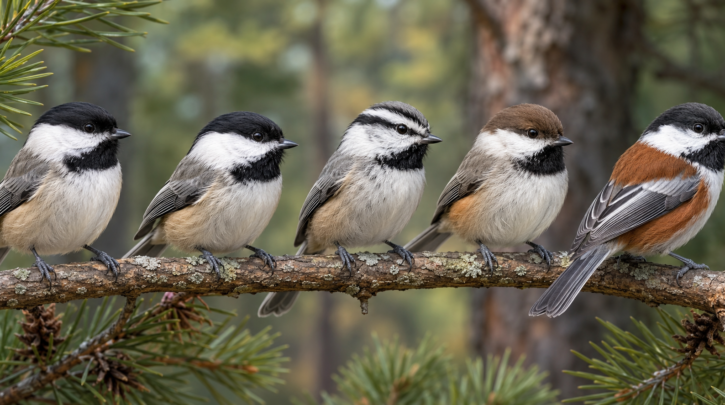

Five chickadee species cover nearly all of North America between them, and two of them — Black-capped and Carolina — look so alike that song, not plumage, is often the only reliable way to separate them where their ranges meet.
Black-capped Chickadee
- Black cap and bib, crisp white cheeks, gray back and wings, buffy underside with a light rufous wash along the flanks
- The larger of the two most widespread species
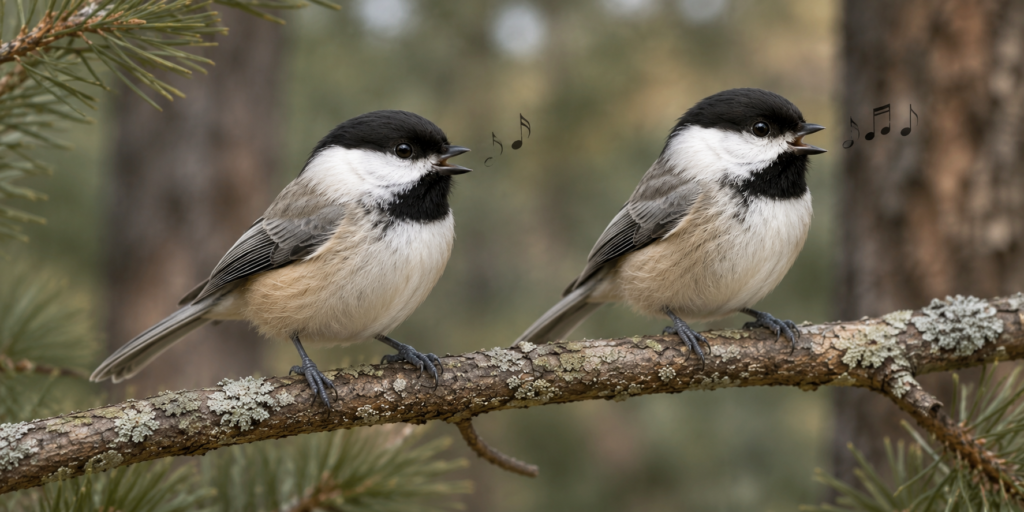
- Song: a clear, whistled two-note “fee-bee,” with the first note higher
- Range: most of the northern United States and Canada
Carolina Chickadee
- Nearly identical plumage to Black-capped — black cap and bib, white cheeks, gray back
- Slightly smaller and more compact than Black-capped
- Song: a faster four-note whistle, often rendered as “fee-bee-fee-bay,” distinctly quicker than Black-capped’s simple two-note song
- Range: the southeastern United States
Black-capped vs. Carolina: When Plumage Fails, Listen
In most of their respective ranges, range alone settles the question. The problem is the overlap zone — a narrow band running roughly through the mid-Atlantic and lower Midwest — where both species occur and plumage differences are subtle enough to be unreliable. Song is the more dependable field mark here: Black-capped’s simple two-note whistle versus Carolina’s faster four-note version.
The Black-capped/Carolina Hybrid Zone
Where the two species meet, they interbreed in a well-documented, genetically studied hybrid zone. Hybrid individuals can sing atypical, mixed, or even garbled versions of either species’ song, and research has found evidence of reduced fitness in hybrids compared to either parent species — and the zone itself has been tracked shifting northward over recent decades, a change generally attributed to a warming climate favoring the more southern-adapted Carolina Chickadee.
Mountain Chickadee
- Black cap and bib and white cheeks similar to Black-capped, but with a distinct white eyebrow stripe above the eye that neither Black-capped nor Carolina shows
- Overall grayer, with less of the buffy wash seen on Black-capped
- Range: coniferous forest across the mountainous western United States and western Canada
Boreal Chickadee
- A brown cap rather than black — immediately distinct from every other species on this list
- Brownish back and a brown wash along the flanks
- Quieter, more subdued vocalizations than Black-capped
- Range: boreal and taiga forest across Canada and Alaska, rarely seen far south of the Canadian border
Chestnut-backed Chickadee
- Black cap paired with a rich chestnut, or rufous, back and flanks — the most colorful and distinctive plumage of the five species
- Range: coastal conifer forest from southern Alaska down through coastal California
Two of these five species are nearly identical in plumage and are told apart mainly by song — a genuine rarity among common backyard birds, where color usually does most of the work.
Sexing Chickadees: A Note Before You Try
All five species are visually monomorphic — males and females look essentially identical in the field, a pattern covered in full in our male vs. female guide. Don’t expect a reliable field mark for sex the way you might with a bluebird or an oriole.
What to Do Once You’ve Made an ID
Identified a chickadee investigating a cavity or nest box in your yard? See our nest cavity guide for the species’ unusual excavate-or-reuse nesting strategy, and our chick-a-dee call guide if you hear an unusually long or urgent-sounding alarm call nearby.
Not sure which species is visiting your yard? Our binoculars buying guide covers the optics that make subtle marks like the Mountain Chickadee’s eyebrow stripe easy to see at typical backyard distances.
Range Overlap Beyond the Hybrid Zone
Mountain and Chestnut-backed Chickadees overlap in parts of the Pacific Northwest, though their distinct cap and back coloring makes them far easier to separate at a glance than Black-capped and Carolina are. Boreal Chickadee overlaps with Black-capped across much of the Canadian boreal forest, but the brown-versus-black cap is an immediate, unambiguous field mark that settles the question without needing to rely on song at all.
Size as a Secondary Clue
All five species are similar in overall size, generally in the four-to-five-and-a-half-inch range, with Carolina running slightly smaller than Black-capped on average. This size difference is genuinely useful only when both species are visible together at the same feeder, since it’s far too subtle to judge reliably from a single bird alone.
Juveniles
Juvenile chickadees of all five species resemble adults fairly closely soon after fledging, without the dramatic plumage difference seen in some other backyard birds between juvenile and adult stages. A slightly duller, less crisp cap and cheek pattern is sometimes visible on very recently fledged young, but this difference fades quickly within the first several weeks of independence.
A Family Best Identified by Combining Clues
Given how close several of these species look, combining range, cap color, and song gives a far more reliable identification than relying on any single feature alone — particularly in the Black-capped and Carolina overlap zone, where song is often the deciding factor rather than a supporting one.