
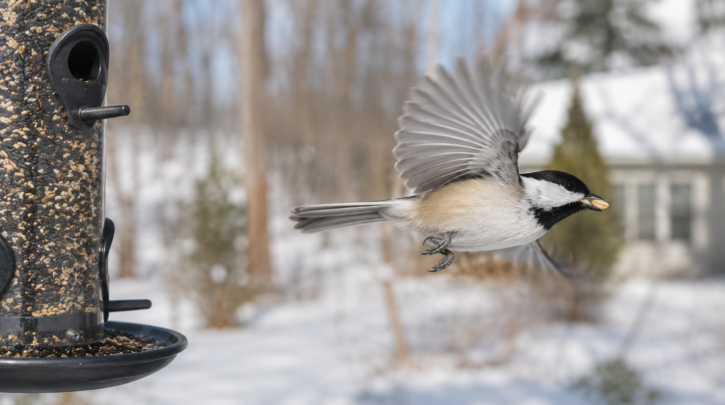

Watch a feeder for ten minutes on a summer afternoon and a chickadee might visit five or six times, never staying more than a few seconds. That rapid-fire pattern isn’t restlessness — it’s a deliberate feeding and caching strategy that looks completely different depending on the season.
The Grab-and-Go Pattern
Unlike larger birds that settle in and eat multiple seeds per visit, chickadees typically take a single seed, fly to nearby cover, and either eat it or cache it before returning for another. This pattern trades efficiency at the feeder for safety — spending less time exposed at an open perch matters for a bird that sits fairly low on the local predator list. Over a full day, a chickadee may visit a well-stocked feeder dozens of times rather than a handful of longer visits.
Caching: One Seed, One Hiding Spot
A striking share of those visits end in caching rather than eating. Chickadees are scatter-hoarders, meaning each cached seed goes into its own separate hiding spot — under bark, in a cluster of pine needles, in a crevice — rather than one central stockpile, spread across a home range that can include thousands of individual cache sites. Research on food-caching birds has found that a chickadee’s hippocampus, the brain region tied to spatial memory, actually grows larger during the caching-heavy months of fall, supporting the memory demands of tracking that many locations.
Seasonal Shift in Visit Frequency
| Season | Typical Visit Pattern | Why |
|---|---|---|
| Fall | Highest frequency; heavy caching | Building winter food reserves while insects decline |
| Winter | High frequency, especially early morning and late afternoon | Replacing overnight energy loss and stocking up before dusk |
| Spring | Moderate; shifts toward live insects as available | Insect protein becomes more available and more valuable for breeding condition |
| Summer | Lower feeder dependence | Insects are abundant; feeders supplement rather than sustain |
Morning and Evening Peaks
Even within a single day, visits aren’t evenly spread. Feeder activity tends to spike shortly after sunrise, when overnight fat reserves are at their lowest point and birds need to refuel quickly, and again in the hour or two before dusk, when chickadees are topping off reserves ahead of an overnight fast. A feeder that runs empty right before dusk in winter is a worse gap than one that runs empty mid-afternoon, for exactly this reason — see how they survive winter for why that evening fueling matters so much.
Why They Don’t Just Sit and Eat
Beyond predator exposure, a chickadee’s small body size means it can only hold a limited amount of food in its crop at once, so multiple short visits are simply more efficient than trying to gorge during one long stay. Caching adds a second reason: a seed eaten immediately provides one meal, while a seed cached provides a meal on a day when the bird can’t find food at all — a hedge against exactly the kind of bad-weather stretch that makes winter survival difficult.
How Many Feeder Visits Add Up to a Day’s Energy
Estimating a precise visit count is difficult because it varies so much by weather, daylight length, and individual bird, but researchers studying winter foraging in small songbirds generally find that cold, short winter days push visit frequency noticeably higher than mild days, since a chickadee has less daylight to gather the same amount of food and colder temperatures raise the energy cost of simply staying warm between visits. A string of bitterly cold days with limited daylight is exactly the scenario where feeder reliability matters most, since the margin for a bird to make up a missed visit later in the day narrows considerably as winter days shorten.
Does One Chickadee Always Come Back, or Is It Different Birds?
It’s often genuinely the same individual, not a rotating cast, at least within a single flock’s territory. Banding studies that track marked individuals have shown that a given chickadee tends to make repeated, predictable visits to the same feeder throughout a season, following a foraging circuit that includes that feeder as one stop among several. Watching what looks like “a chickadee” visiting every few minutes for an hour is frequently one or two individual birds cycling through a short, repeated route rather than a large number of different birds passing through once each.
Weather’s Effect on Visit Timing
Beyond the general seasonal pattern, day-to-day weather shifts visit timing noticeably. A sudden cold front or the approach of a winter storm often triggers a visible spike in feeder activity in the hours beforehand, as birds sense the pressure change and feed aggressively ahead of a period when foraging will be harder. The reverse is also true — a mild, calm stretch in the middle of winter can bring visit frequency down closer to what’s typical in early fall, since energy demands ease along with the weather.
Comparing Chickadee Visits to Other Feeder Birds
Larger birds like cardinals or jays tend to make fewer, longer visits, settling in and working through several seeds before moving on, which stands in sharp contrast to the chickadee’s rapid one-seed-and-retreat approach. This difference isn’t about manners so much as body size and predator exposure — a cardinal is large enough to defend itself or simply outrun most feeder-area threats, while a chickadee’s small size makes minimizing exposure time the safer strategy regardless of how much food is available. Watching a mixed group of feeder birds side by side over a single morning makes this contrast in foraging style easy to see firsthand.
What This Means for Feeding Habits
Because chickadees make so many short visits rather than a few long ones, feeder capacity matters less than reliability. A smaller feeder that’s consistently full serves chickadees just as well as a much larger one, since no single visit draws down much seed. What actually disrupts the pattern is an empty feeder at a peak time — particularly right after sunrise or right before dusk in winter — which forces birds to spend extra energy finding an alternate source exactly when they can least afford to. For what to keep it stocked with, see what chickadees eat.