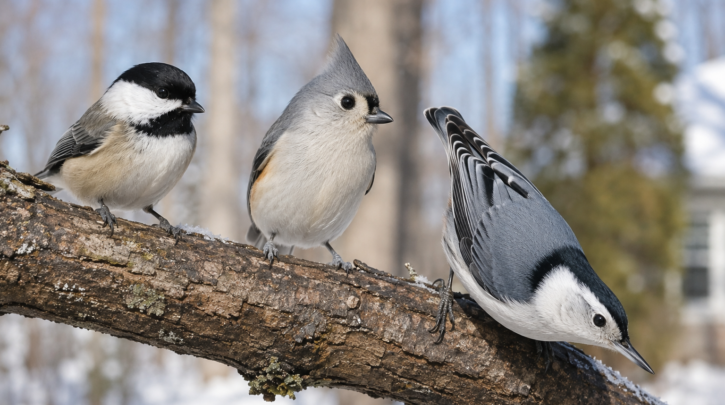

These three birds show up at the same feeders, join the same winter flocks, and get mixed up by beginning birders more than almost any other backyard combination. The good news is that once you know what to look for, they’re actually easy to separate — by shape and behavior even before color comes into play.
Quick Visual Differences
| Feature | Chickadee | Tufted Titmouse | White-breasted Nuthatch |
|---|---|---|---|
| Size | Smallest of the three, ~4.75-5.25 in | Slightly larger, ~6.5 in, with a crest | Stocky, ~5.5 in, short tail |
| Head | Black cap and bib, white cheeks | Gray crest, no cap/bib pattern | Black cap on males, no bib |
| Body shape | Round, small-billed | Round with a pointed crest | Compact, almost neckless |
| Typical call | “chick-a-dee-dee-dee” | Loud “peter-peter-peter” | Nasal “yank-yank-yank” |
| Signature behavior | Acrobatic, hangs upside-down on twigs | Bold at feeders, cracks seed with feet | Climbs down tree trunks head-first |
The Fastest Field Mark: Behavior
Before plumage even registers, behavior usually gives it away. A nuthatch is the only one of the three that regularly moves down a tree trunk head-first, a posture almost no other North American bird uses regularly. A titmouse tends to grab a single seed and fly off to hammer it open somewhere else rather than eating at the feeder, while a chickadee does the same seed-grab-and-retreat pattern but is noticeably smaller and quicker, often hanging briefly upside-down from a thin twig while foraging — something a titmouse’s larger body rarely attempts.
Chickadee Field Marks
A crisp black cap and black throat bib, set against bright white cheeks, is the giveaway across all five North American chickadee species, though exact shading and flank color vary — details covered in the species ID guide. No titmouse or nuthatch shares this exact cap-and-bib pattern, which makes the chickadee the easiest of the three to identify at a glance once you know the pattern to look for.
Titmouse Field Marks
The Tufted Titmouse is the only one of the three with an actual crest — a small gray peak on top of the head that’s visible even at a distance. It’s soft gray overall with a wash of rusty orange along the flanks and a black patch just above the bill. It’s also noticeably the largest and boldest of the three at a feeder, often displacing chickadees from a preferred perch despite the two species traveling together.
Nuthatch Field Marks
White-breasted Nuthatches have a stocky, almost tailless silhouette, a long straight bill, and a solid black cap in males (gray in females) without any bib pattern beneath it. The head-first descent down a trunk is the single most reliable identifier in the field — no chickadee or titmouse forages that way. Red-breasted Nuthatches, a separate but related species, show the same head-first climbing behavior at a noticeably smaller size with a rusty breast and a bold eye stripe.
Why They’re Often Seen Together
All three species regularly join the same mixed-species winter flocks, with chickadees frequently acting as the group’s lead sentinel. That shared social structure is exactly why beginners run into all three at once and struggle to sort them out — they’re not just visually similar in passing glimpses, they’re genuinely traveling together for real ecological reasons.
Call Differences in More Detail
Beyond the classic chick-a-dee call, chickadees also give a clear, whistled “fee-bee” song, two notes with the first higher than the second — often mistaken for a Black-capped Chickadee simply repeating its own name in slow motion. The titmouse’s “peter-peter-peter” is louder, more insistent, and repeated in a fast series, easily audible from much further away than either chickadee call. The nuthatch’s nasal “yank-yank” is lower-pitched and more mechanical-sounding than either of the other two, almost like a tiny tin horn, and it’s often the first clue that a nuthatch is nearby even before it’s spotted climbing down a trunk.
A Note on Red-Breasted Nuthatches
Where White-breasted Nuthatches favor deciduous and mixed woodland, the smaller Red-breasted Nuthatch prefers conifers and shows a rusty-orange breast along with a bold black eye stripe bordered by white — a genuinely different look from the plain white underside of a White-breasted Nuthatch. Both nuthatch species share the head-first trunk-climbing behavior, so that field mark alone confirms the genus even when the specific species takes a closer look to pin down.
Range Overlap Across the Three
Tufted Titmice and White-breasted Nuthatches both range across most of the eastern and central United States, overlapping broadly with both Black-capped and Carolina Chickadee territory, which is exactly why the three end up sharing feeders and flocks across such a wide area. In the West, Mountain and Chestnut-backed Chickadees overlap instead with Red-breasted Nuthatches and Mountain or Oak Titmice — different but ecologically similar species that fill the same roles and create the same identification challenges regionally.
Size Comparison in Context
Placed side by side, the size difference is more obvious than field guide measurements alone suggest — a titmouse looks noticeably bulkier and longer-tailed next to a chickadee, while a nuthatch, despite being close to a chickadee’s overall length, reads as stockier and shorter-tailed by comparison. Once you’ve watched all three at the same feeder a few times, this relative size and shape difference often becomes the fastest identifier of all, faster even than waiting to hear a call or catch a clear look at head pattern.
Juveniles and Molt: A Common Source of Confusion
Freshly fledged juveniles of all three species can look duller and less crisply marked than adults for the first several weeks out of the nest, which occasionally throws off an otherwise confident identification in mid-to-late summer. A young chickadee’s cap and bib pattern is still present but softer-edged, a young titmouse’s crest is shorter and less defined, and a young nuthatch may show a less solidly black cap. Behavior — the trunk-climbing, the seed-grabbing, the flock association — remains reliable even when plumage alone is a little ambiguous on a juvenile bird.
A Fast Mental Checklist
- Crest visible? → Titmouse
- Climbing head-first down a trunk? → Nuthatch
- Black cap and black bib together, no crest? → Chickadee
- Hanging upside-down from a thin twig while feeding? → Almost certainly a chickadee