
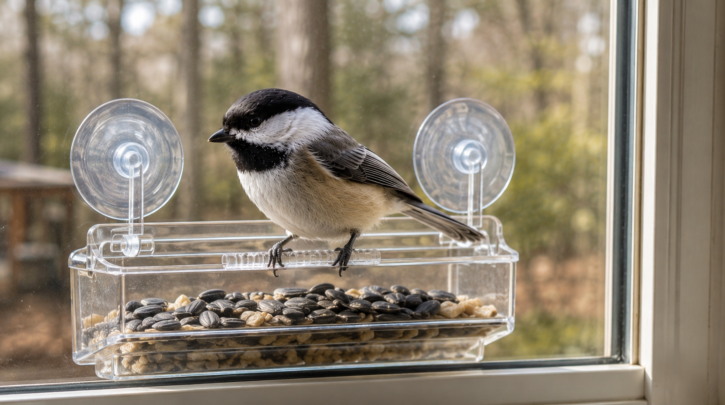

Few backyard birds tolerate close human presence as readily as chickadees do, which makes this species a natural fit for window feeders — and for hosts patient enough to work toward genuine hand-feeding.
What We Looked For
- Reliable suction-cup mounting that holds securely across temperature swings
- Clear materials for genuinely unobstructed close-up viewing
- Easy removal for filling and cleaning without disturbing the mount
- A size appropriate for small birds rather than a feeder built for larger species
Duncraft Classic Window Feeder
An affordable, straightforward suction-mounted feeder that attaches directly to glass, bringing chickadees and similarly sized birds close enough for genuinely detailed observation. Its simple clearview plastic construction keeps cost low while still delivering the core window feeding experience.
See: Duncraft Classic Window Feeder
Duncraft Mini Window Feeder
A compact option sized to fit smaller windowpanes, including older window styles that a larger feeder wouldn’t suit. Its small footprint makes it a genuinely good option for apartments or anyone without a large exterior wall to work with.
See: Duncraft Mini Window Feeder
Why Window Feeders Work So Well for This Species
Because chickadees are naturally bold and quick to investigate new food sources, they’re typically among the first species to discover and commit to a window feeder, often faster than more cautious birds that take longer to tolerate feeding this close to a house.
From Window Feeding to Hand-Feeding
A well-established window feeder is often the natural next step toward genuine hand-feeding — once chickadees are comfortable feeding within arm’s length of a window, extending an open palm with sunflower seed nearby, with patience and consistency, can gradually lead to a bird landing directly on the hand. See our feeder guide for more on building this relationship over time.
Placement Tips
- Choose a window with a clear view from indoors, ideally one that doesn’t face intense afternoon sun that could overheat the feeder
- Apply a decal or marker on nearby glass to reduce the risk of window strikes as birds become more frequent visitors
- Keep the feeder clean and dry, since a window feeder often sits more exposed to direct weather than a pole-mounted feeder
Curious what it actually takes to get a chickadee to land on your hand? Revisit our attracting guide for the patience-based approach that works best.
Cleaning a Window Feeder
Because a window feeder sits so close to a living space, keeping it clean matters both for bird health and for general household tidiness — wipe down the suction cups and feeder surface regularly, and remove any wet or spoiled seed promptly to avoid attracting pests to the window itself.
Managing Window Strike Risk
Any feeder placed directly on glass increases local bird traffic near a reflective surface, making a strike-prevention decal or pattern on the surrounding window a reasonable precaution alongside the feeder itself, particularly on a large window with a lot of reflective surface area beyond the feeder’s immediate footprint.
Combining a Window Feeder With a Pole Feeder
Running a window feeder alongside a standard pole-mounted sunflower or suet feeder gives chickadees more than one feeding option and can reduce crowding at either single station during busy periods, while still preserving the close-up viewing experience the window feeder is specifically designed and intended to provide in the first place.
Seasonal Window Feeder Demand
Window feeder activity often peaks in winter alongside overall feeder demand across this species, though a well-established window feeder can see steady use throughout the year once local chickadees have learned to treat it as a reliable food source.
A Genuinely Rewarding Setup for Beginners
Because chickadees respond so quickly and reliably to a window feeder, this setup is often recommended as one of the most satisfying first steps into backyard birdwatching, delivering close, detailed views within days rather than requiring weeks of patient waiting.
Final Thoughts
A window feeder is one of the lowest-cost, highest-payoff purchases in backyard birding, and chickadees are the species most likely to make it feel worth it within the first week. Few purchases anywhere in this hobby deliver results this quickly, reliably, and cheaply — a genuinely easy first recommendation for anyone just getting started.