
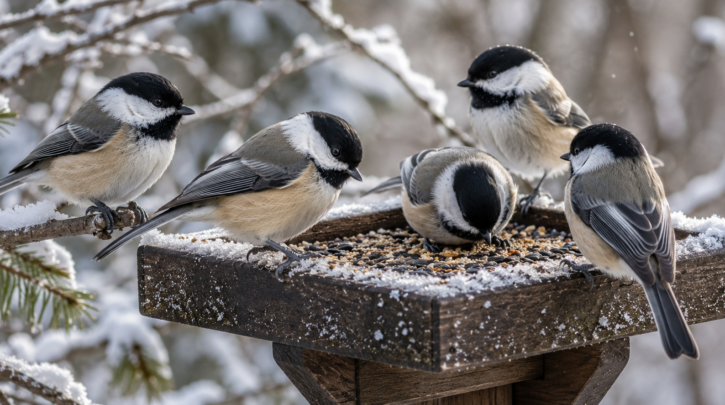

Chickadees don’t fit neatly into a single migration category of birds — they’re primarily non-migratory residents, like woodpeckers, but with an occasional irruptive tendency more reminiscent of winter finches.
Mostly Resident, Like Woodpeckers
Across most of their range, all five chickadee species stay in the same general territory year-round, similar to the resident pattern of the woodpecker. There’s no regular seasonal departure and return the way a partial migrant like a bluebird or an obligate migrant like an oriole shows.
Occasional Irruptions, Like Winter Finches
Where chickadees diverge from a purely resident pattern is in periodic, irregular southward movements, documented most often in Black-capped Chickadee and, to a lesser extent, Boreal Chickadee. These irruption-style movements are generally tied to a poor local seed or cone crop, or to a population boom following an unusually successful breeding season creating more competition for limited local resources than the area can support.
How This Differs From a True Winter Finch Irruption
Chickadee irruptions are less dramatic and less predictable than the well-documented Pine Siskin and Common Redpoll irruptions of the finch — they happen less frequently and involve less consistent, less well-understood triggers, making them more of an occasional exception to an otherwise resident pattern than a defining, regular feature of the species’ biology.
Altitudinal Movement in Mountain Populations
Mountain Chickadee shows some seasonal movement to lower elevations in winter, a modest, short-distance shift rather than a true migration, similar in spirit to local movements documented in some other resident mountain-dwelling species.
A Genuine Blend of Two Patterns
This makes chickadees a useful bridge between two migration strategies— mostly resident, but capable of the same kind of food-driven, unpredictable movement that defines irruptive finches, just at a smaller scale and with less regularity.
Want to know what a resident chickadee’s winter actually looks like day to day? See our winter survival guide for the physiological adaptations involved.
What This Means for Backyard Hosts
Because most chickadee populations are resident, a feeding station pays off across every season rather than only during a narrow migratory window, though a host in the northern part of the range might occasionally notice an unusual influx of extra birds during an irruption year, similar in spirit to a modest local version of a winter finch event.
Recognizing an Irruption Year Locally
A noticeably larger-than-usual chickadee flock at a feeder in fall or winter, especially in northern latitudes, can be a sign of exactly this kind of irregular movement rather than simply a good year for the local resident population. Because chickadee irruptions are less studied and less predictable than winter finch irruptions, there’s no equivalent published forecast to consult ahead of time.
Tracking Long-Term Patterns
Keeping informal notes on flock size from year to year, particularly during fall and early winter, can help a host notice these irregular fluctuations over time, even without access to the kind of formal regional forecasting available for the more thoroughly studied irruptive finch species.
A Species That Defies Simple Categorization
More than perhaps any other bird families, chickadees resist being filed neatly into a single migration category, which is itself a genuinely interesting reminder that biological categories like “resident” or “irruptive” often describe a dominant tendency rather than an absolute, universal rule.
Comparing Migration Strategy
There are resident species, partial migrants, obligate long-distance migrants, irruptive nomads, and now a genuine hybrid of resident and occasionally irruptive behavior — a reasonably complete survey of how differently North American songbirds have solved the same basic seasonal food-availability problem.
A Fitting Close to This Particular Question
Chickadees turning out to blend two previously distinct migration patterns feels appropriate given how often this family has already shown up as a genuine middle ground elsewhere — between excavating and reusing a cavity, and now between staying put and occasionally moving on when conditions genuinely demand it of the local population.
Final Thoughts
Migration strategy in this family turns out to mirror its nesting strategy closely — flexible, opportunistic, and genuinely resistant to being described by any single simple rule that would apply cleanly and consistently across every single population of this widespread family.
That flexibility, more than any single fixed trait, may be the closest thing to a unifying theme across the whole chickadee family covered throughout this site.