
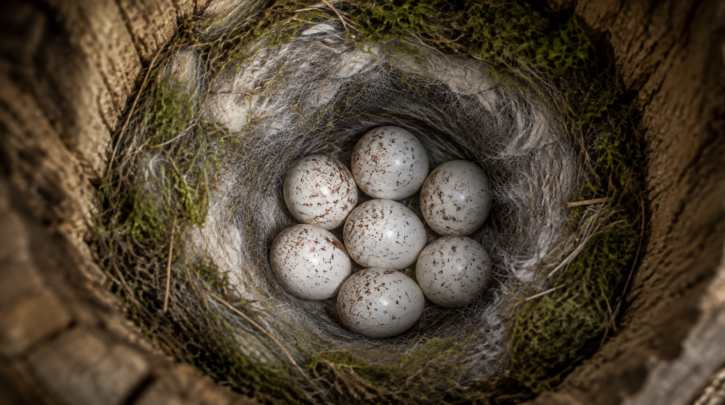

Chickadees lay some of the largest clutches of any species — a real contrast to the smaller broods typical of bluebirds, orioles, or woodpeckers, and a detail that shapes just how demanding the following few weeks become for both parents.
This site participates in affiliate programs. If you buy through a link on this page, we may earn a commission at no extra cost to you. Affiliate disclosure
Egg Color and Pattern
Chickadee eggs are white with fine reddish-brown speckling, concentrated more heavily toward the larger end of the egg. This pattern sits between the plain white eggs of a woodpecker and the more heavily marked eggs of an open-nesting bird like an oriole, offering modest camouflage value appropriate to a fully enclosed cavity nest.
Clutch Size: Notably Large
A typical chickadee clutch runs six to eight eggs, with clutches of up to ten documented in some cases — a considerably larger brood than most other cavity-nesting songbirds attempt in a single nesting effort.
Why Such a Large Clutch
A large clutch size likely reflects both the relatively short lifespan typical of small songbirds and the genuine payoff of investing heavily in a single well-provisioned nesting attempt when breeding conditions and food supply allow for it, particularly given how insect-rich the spring and early summer season typically is across most of the chickadee’s range.
Incubation
- Incubation is done by the female alone
- Duration: roughly 12 to 13 days
- The male feeds the incubating female throughout this period rather than sharing incubation duty directly
A Genuine Test of Provisioning Ability
Because clutch size runs so much larger than many other species, successfully raising a full chickadee brood to fledging is a genuinely demanding test of how much insect prey a pair’s territory can actually support, covered in more detail in our baby chickadees guide.
Monitoring an Active Nest
Because the nest sits inside a fully enclosed cavity, whether self-excavated or reused, direct observation of eggs generally isn’t possible without opening a nest box, which should be done briefly and infrequently if attempted at all. Watching adult activity at the entrance — regular visits, and eventually the snake-like hiss covered in our nest cavity guide if the cavity is disturbed — is the standard way to confirm activity without direct interference.
Eggs about to hatch? See our guide to baby chickadees and fledging for what a brood this large actually requires from both parents.
A camera nest box like the Birdfy Nest Duo makes this even easier, letting you see inside the box without disturbing the female.
Comparing Clutch Size to Other Bird Species
A six-to-eight-egg clutch is genuinely large compared to most other species — considerably bigger than a typical bluebird or oriole clutch, and closer to the larger end seen in Northern Flicker on the woodpecker side. This difference in reproductive strategy shapes nearly everything about the demanding weeks that follow hatching.
What Happens If Not All Eggs Hatch
With a clutch this large, it’s not unusual for one or two eggs to fail to hatch even when the rest of the brood develops normally, and the sheer size of a typical clutch provides some natural buffer against this kind of individual loss without necessarily threatening the overall success of the nesting attempt.
Egg-Laying Timing
Eggs are laid at a rate of roughly one per day until the clutch is complete, meaning a full eight-egg clutch takes over a week to lay in its entirety before full incubation actually begins — a genuinely extended pre-incubation period compared to species laying smaller clutches over a shorter span.
Why Timing the Clutch Correctly Matters
Because a large clutch takes longer to lay and incubate than a smaller one, and because the insect boom that will feed the resulting brood is itself time-limited, chickadee pairs face real pressure to time egg laying correctly relative to expected local insect abundance a few weeks later, when the eggs will have hatched and chicks will need feeding.
A Genuine Reproductive Gamble
Committing to such a large clutch is, in a sense, a genuine gamble on future food availability — a pair that times things well and encounters a strong caterpillar season can fledge most or all of a large brood, while poor timing or a weak insect year can mean considerably lower success despite starting from the exact same initial clutch size and effort.
Final Thoughts
Clutch size alone tells a genuine story about a species’ broader life history, and the large chickadee clutch is a clear signal of just how much this family leans on a short, intense burst of insect-fueled reproduction each year, rather than spreading effort across multiple smaller broods the way some other backyard birds tend to do.