
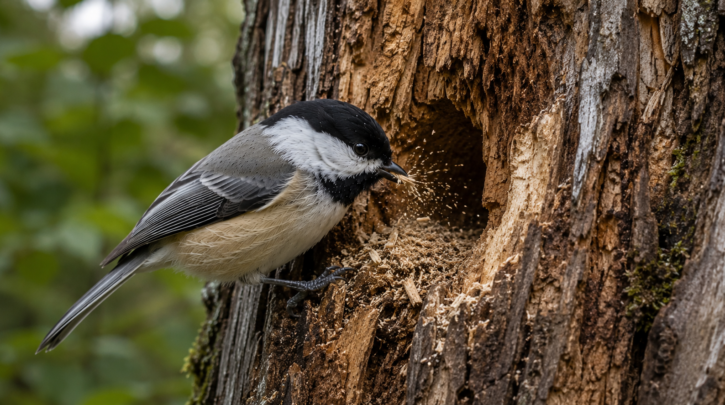

Chickadees don’t fit neatly into either the full-excavator category woodpeckers occupy or the secondary-cavity-user category bluebirds occupy. They genuinely do both, depending on what’s available.
Self-Excavation: Only in Soft Wood
Chickadees can chisel out a shallow cavity themselves, but only in genuinely soft, decayed wood — a rotting birch or alder snag is a classic choice. Unlike a woodpecker, a chickadee simply doesn’t have the bill strength to excavate solid or even moderately firm wood, so self-excavation is limited entirely to wood that’s already well into the decay process.
How Long Self-Excavation Takes
Working in sufficiently soft wood, a pair can complete a shallow cavity in roughly one to two weeks, with the female generally doing more of the excavation work than the male, though both sexes may participate to some degree.
Or Reusing What’s Already There
Just as often, chickadees skip excavation entirely and move into an existing cavity — an old woodpecker hole, a natural knot cavity, or a nest box. See our old cavities guide for how directly this ties back to the excavation work of the woodpecker.
Nest Construction Once a Cavity Is Ready
Regardless of whether the cavity was self-excavated or inherited, the female builds the nest cup largely on her own, typically starting with a moss base and lining it with soft material such as animal fur, hair, or other fine fiber. This moss-then-fur construction produces a noticeably soft, well-insulated cup compared to the sparser grass nests built by some other cavity-nesting songbirds.
Cavity Height and Placement
Chickadee cavities tend to sit relatively low compared to some other cavity nesters, commonly anywhere from about one to fifteen feet off the ground, and the preferred entrance hole diameter is small — roughly 1 1⁄8 inches — considerably smaller than the 1½-inch hole a bluebird box requires.
A chickadee doesn’t choose between excavating and reusing as a fixed strategy — it simply takes whichever option is actually available, soft wood or an existing hole, whichever comes first.
A Remarkable Defense Display
If a nesting female is disturbed inside the cavity, she may perform a startling hissing, snake-like display — producing a hiss and thrashing movement that mimics an aggravated snake closely enough to startle a potential predator or intruder into retreating rather than pressing further into the cavity. This defense is genuinely distinctive among backyard birds and reflects just how vulnerable a bird sitting deep inside a narrow cavity actually is without room to flee.
A Behavior Sometimes Shared by Nestlings
This snake-mimicking hiss isn’t limited to incubating females — older nestlings disturbed inside the cavity have been documented performing a similar hissing display of their own, suggesting the behavior may be at least partly instinctive rather than something learned purely through adult example.
What Comes Next
Once the nest cup is finished, egg laying typically begins within days. See our eggs guide for clutch size and incubation, and our baby chickadees guide for what happens after hatching.
Thinking about putting up a nest box instead of waiting for a natural cavity? See our nest box guide for the correct hole size and design details.
Why This Middle-Ground Strategy Works
Being able to either excavate soft wood or accept an existing cavity gives chickadees genuinely more nesting flexibility than either a strict excavator or a strict secondary user has, which is likely part of why the family adapts so readily to a wide range of habitats, from mature forest to suburban yards with only modest dead-wood availability.
Choosing Between the Two Strategies
There’s no evidence chickadees strongly prefer one approach over the other when both are genuinely available — the decision seems to come down almost entirely to what a pair actually finds in its territory during the narrow window when nest-site selection happens each spring, rather than any fixed behavioral preference for excavating over reusing.
Regional Variation in Strategy
In regions with abundant standing dead wood and a healthy local woodpecker population, chickadee pairs likely rely more heavily on old cavities than on self-excavation, simply because ready-made options are more available. In more developed areas with less dead wood retained, self-excavation in whatever soft wood remains, or a nest box, becomes correspondingly more important.
A Strategy Worth Recognizing in the Field
Watching a pair investigate several potential sites before settling on one — sometimes a natural cavity, sometimes a spot that looks promising for excavation — offers a genuinely interesting window into this flexible decision-making process, something not easily observed in species locked into a single fixed nesting strategy.