

Chickadee lifespan is a story about more than just aging — survival in this family is closely tied to social rank within a winter flock, and to a genuinely remarkable seasonal change in brain structure that supports one of the more impressive memory feats in the songbird world.
Typical Lifespan
Population-wide average lifespan for Black-capped Chickadee is often cited in the two-to-three year range once first-year mortality is factored in, but banding records show individuals living considerably longer — confirmed records exist of birds living past a decade in the wild, well beyond the population average.
The First Year Is the Hard Part
As with most small songbirds, a large share of chickadee mortality happens in the first year of life, driven by predation, starvation, and inexperience finding food and shelter. Birds that survive that first year have meaningfully better odds for every year after, particularly once they’ve established a stable position within a local winter flock.
Dominance Hierarchies and Survival
Winter chickadee flocks maintain a stable dominance hierarchy, or pecking order, and a bird’s rank within that hierarchy has real consequences for survival. Higher-ranked individuals get priority access to the best food sources and safer, more sheltered territory, while lower-ranked birds face measurably higher risk during the leanest, coldest stretches of winter.
How Rank Is Established
Rank within a flock is generally established and maintained through repeated social interactions rather than physical fighting, with more dominant individuals typically displacing subordinates from preferred feeding positions through posture and vocal signals rather than direct confrontation.
A Remarkable Seasonal Memory Adaptation
Chickadees cache thousands of individual food items each fall, each hidden in a different location, and rely on genuinely precise spatial memory to relocate a meaningful share of them later. Supporting this feat requires real neurological investment: the hippocampus, the brain region most associated with spatial memory, has been shown to measurably enlarge in fall through new neuron growth, then shrink back once the caching season’s memory demands ease.
Why This Matters for Winter Survival
This seasonal hippocampal growth isn’t just an interesting research finding — it directly supports winter survival by allowing a chickadee to relocate cached food during the exact stretch of the year when fresh food is hardest to find. Individuals with better cache recall likely have a genuine survival advantage over those with weaker spatial memory during a difficult winter.
Winter Torpor: A Second Survival Adaptation
Beyond caching and memory, chickadees can enter a controlled, reversible state of nightly hypothermia called torpor, lowering body temperature by several degrees during particularly cold nights to conserve energy. See our winter survival guide for how this works alongside caching to get a chickadee through the harshest stretches of the year.
What Increases Survival
- A reliable suet and seed source, particularly valuable in winter when natural food is scarce
- Retained dead wood and natural cavities offering both nesting and roosting options
- Establishing and maintaining a favorable position within a local winter flock
- Reduced pesticide use, preserving the insect populations chickadees rely on heavily during the breeding season
Want to support chickadees through the toughest stretch of the year? See our suet and seed guide for the food that matters most when natural options are scarce.
How Banding Studies Track Chickadee Survival
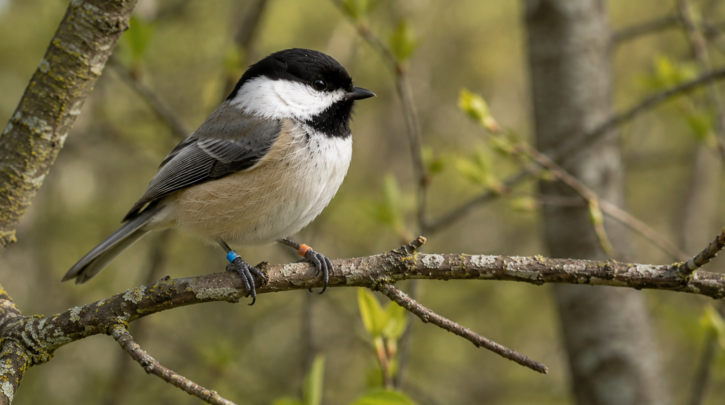
Much of what’s known about chickadee lifespan and dominance-related survival comes from long-running color-banding studies, where individual birds are fitted with a unique combination of colored leg bands that let researchers identify and track specific individuals within a flock over multiple years without needing to recapture them repeatedly.
Comparing Lifespan to Other Bird Species
A typical adult lifespan in the several-year range, with confirmed records well past a decade, puts chickadees broadly in line with the other resident and partially migratory species. What sets this family apart isn’t raw lifespan but the combination of two genuinely distinct survival adaptations — caching-supported memory and nightly torpor — working together rather than relying on just one.
A Family Built Around Cognitive and Physiological Adaptation
Between the seasonal hippocampal changes supporting food-cache memory and the controlled nightly hypothermia covered in our winter survival guide, chickadees rely on genuinely sophisticated internal adaptations to survive winter, rather than migration or simple bulk feeding alone.
Why Rank and Memory Are Connected
Higher-ranking birds within a flock often secure access to better caching sites in addition to better feeding positions, meaning social rank and the memory system supporting cache recovery work together rather than independently — a dominant bird with strong spatial memory is positioned to outperform both a subordinate bird and a dominant bird with weaker recall.