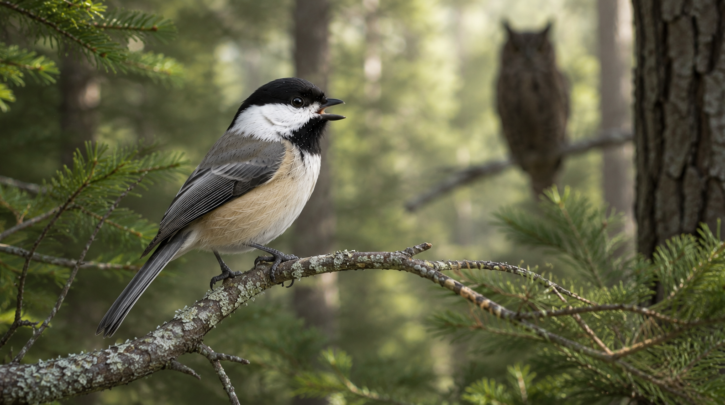

The call that gives chickadees their name isn’t just a generic alarm sound — research has shown it’s a genuinely information-rich signal, with the exact number of notes at the end of the call corresponding to how dangerous a specific predator actually is.
The Basic Call
The namesake call — “chick-a-dee-dee-dee” — functions as a contact and alarm call, distinct from the whistled territorial song covered in our identification guide. It helps maintain contact within a flock, announces food discoveries, and recruits other birds to investigate or respond to a potential threat.
Why the Number of ‘Dee’ Notes Matters
Research on Black-capped Chickadees, most notably work published by researcher Christopher Templeton and colleagues, found that the number of “dee” notes at the end of the call scales with how threatening a specific predator actually is to the chickadee — more dees for genuinely dangerous predators, fewer dees for predators that pose comparatively little real risk.
Why Small Predators Get More ‘Dees’ Than Large Ones
Counterintuitively, a small, agile predator like a pygmy owl triggers a call with more “dee” notes than a large predator like a great horned owl, even though the great horned owl is far bigger. The explanation comes down to maneuverability rather than size: a small owl can chase and catch a fast-moving chickadee through dense branches in a way a much larger, less agile owl simply can’t manage, making the smaller predator the genuinely more dangerous one despite its size.
Mobbing Behavior
The chick-a-dee call also functions as a recruitment signal for mobbing — a coordinated group response where chickadees and other nearby birds converge on a perched predator, calling and sometimes making brief diving passes to harass it into leaving the area. Other species, including nuthatches and titmice, are known to recognize and respond to chickadee alarm calls even without a chickadee-specific alarm system of their own, treating the call as a reliable general warning signal worth investigating.
A Genuinely Complex Communication System
Beyond predator-specific information, variations in the broader chick-a-dee call are used to communicate about food sources, flock movement, and general contact between birds that have become separated within dense cover. Researchers studying this call have described it as one of the most information-dense vocal systems documented in any songbird, genuinely comparable in complexity to communication systems found in some non-avian species studied for sophisticated signaling.
A chickadee’s alarm call isn’t a single generic warning — the exact number of notes at the end tells other birds specifically how dangerous the threat actually is.
Listening for This in Your Own Yard
With practice, it’s possible to notice the difference between a short, low-urgency call and a longer one with more “dee” notes strung together, particularly if a hawk or owl is genuinely present nearby. A sudden shift from normal contact calling to a longer, more insistent version is a reasonable cue that something worth investigating — a predator, most likely — has been spotted.
How This Compares to Other Bird Species
No other species has a documented communication system this specifically studied and this information-dense. Woodpecker drumming communicates territory and availability through cadence and volume, but the chick-a-dee call goes further, encoding specific, graded information about an identified threat in real time.
Curious what other survival strategies chickadees rely on? See our winter survival guide for the cold-weather adaptations that go well beyond communication alone.
How Researchers Study This Call
Much of the foundational research on chick-a-dee call structure involved recording wild chickadees near taxidermied or live predator models representing different real threats, then carefully analyzing the recorded calls for note count and structure. This kind of controlled field experiment is what allowed researchers to confidently link note count to genuine, measurable predator threat level rather than simply noticing a loose correlation.
Does Every Chickadee Species Show This Pattern?
Most of the detailed research specifically involves Black-capped Chickadee, the most accessible and widely studied of the five species, though related calls in Carolina Chickadee and other close relatives are believed to function similarly given how closely related and vocally similar these species are to one another.
A Call Worth Learning to Recognize
Beyond the scientific interest, learning to distinguish a routine contact call from a longer, more urgent alarm sequence genuinely improves backyard birdwatching — a sudden shift in calling pattern is often the first sign that a hawk, owl, or other predator has entered the immediate area, well before any visual confirmation is possible.
Why This Research Matters Beyond Chickadees
Studies of the chick-a-dee call have influenced broader thinking about animal communication systems generally, offering one of the clearest documented examples of a non-human vocal system encoding specific, graded external information rather than simply signaling generic alarm or excitement.